The 7-Day Whole Child Reset
A Calmer Home Can Start With Just One Week.
If routines have gotten off track, transitions feel harder than they should, or daily power struggles are wearing everyone down, The 7-Day Whole Child Reset gives you a simple, practical place to start.
Created by an educator with 30 years of experience working with children and families, this practical 7-day plan gives parents of children ages 3–10 realistic tools to create more predictable routines, support big emotions, strengthen connection, and bring more calm into everyday family life.
Does
Type 1: Mornings feel rushed before the day even begins. Simple transitions turn into power struggles. Big emotions can take over, and by the end of the day, you're wondering why everything feels harder than it should.
Type 2: Routines feel more predictable. Transitions are smoother. Big emotions still happen, but you have practical tools to respond with more confidence and calm. Your child knows what to expect, and everyday family life feels more connected and manageable.
GET The 7-Day Whole Child Reset FOR $27


🔒100% Secure 256-Bit Security Encryption
Why School Can Feel So Different From Home
You’ve seen your child succeed at school.
They follow routines, move through transitions, participate, help clean up, and handle expectations throughout the day.
Then they get home—and suddenly, everything can feel harder.
The smallest transition becomes a struggle. Big emotions spill over. A simple request can turn into a power struggle.
And you’re left wondering:
“If they can do this at school, why is home so different?”
After 30 years working with children and families, I’ve seen this pattern again and again.
And one of the biggest differences between school and home is something surprisingly simple:
At school, children are surrounded by predictable systems and supports all day long.

What’s Different at School?
Think about everything that surrounds your child during a typical school day.
There are predictable routines. Visual reminders. Clear expectations. Transition warnings. Consistent language. Built-in movement. Adults helping children regulate, refocus, and know what comes next.
These supports don’t eliminate big emotions or challenging moments—but they give children structure they can rely on throughout the day.
At home, life naturally looks different. Schedules change. Parents are juggling dinner, homework, activities, work, siblings, and everything else that comes with family life.
So when your child gets home tired, hungry, overstimulated, or simply ready to let go after holding it together all day, even a small transition can suddenly feel enormous.
The goal isn’t to turn your home into a classroom.
It’s to borrow some of the simple, predictable supports that work well with children—and adapt them for real family life.
That’s the school-to-home bridge.
And it’s the foundation of The 7-Day Whole Child Reset.
It’s Not About “Good” Kids or “Bad” Kids — It’s About the Support Around Them
At school, children are surrounded by simple supports that make the day more predictable. They know what’s happening now, what’s coming next, what’s expected of them, and where to turn when they need help.
Visual schedules that show what's coming next
Transition warnings that prepare children for a change
Predictable routines that help children know what to expect
Regulation tools children can use when emotions get big
Movement & Sensory supports built into the day
Clear, consistent language from the adults around them
Structured environments that make expectations easier to understand

Your child spends the school day surrounded by routines, expectations, reminders, and supports that help make the day predictable.
Then they come home—and home is naturally different.
The structure changes. The demands change. And your child may be tired from managing a full day.
That doesn’t mean something is wrong with your child—or that you’re doing something wrong as a parent.
It simply means the tools that help children navigate their day at school may need to look a little different at home.
That’s where the school-to-home bridge can make such a difference.
When Everyday Family Life Starts Feeling Harder Than It Should
Mornings Can Start Feeling Like a Race
Starting your day in conflict
Sending your child to school already dysregulated
Creating negative patterns that become harder to change
Missing precious connection opportunities that won't come back
Modeling chaos instead of calm for developing brains
after School can feel even harder
Your child comes home tired and emotions spill over
Homework, dinner, or simple requests can become power struggles
Transitions from school to home activities feel unpredictable
You find yourself repeating directions or trying different approaches
By evening, everyone may be running low on patience
And by bedtime, you're ready for a reset
Bedtime routines take longer than you hoped
You wonder what you could have handled differently
You want more connection and less correction
You know your child is capable—you just need practical tools that work at home
You’re ready for family life to feel a little more predictable and manageable
It doesn’t have to be perfect to feel better.
Small changes in routines, expectations, transitions, and the way you respond to difficult moments can make everyday family life feel more manageable.
And you don’t have to figure out where to start on your own.
The 7-Day Whole Child Reset gives you a simple plan for bringing some of the predictability and support children experience at school into your home—in a way that works for real family life.
What Could Feel Different in Just 7 Days
Small Changes Can Make a Big Difference in Everyday Family Life
CALMER MORNING:
Significantly reduced morning preparation time
From multiple reminders to get dressed → child dressing independently
From breakfast battles → pleasant family conversation
From racing out angry → hugging goodbye with love
After-School Revolution:
From meltdowns → calm transition routine
Homework wars → more independent work completion
Sibling battles → improved cooperation
"I hate you!" → "Can we do our connection time?"
CALMER EVENINGS:
Smoother transitions around dinner, screens, and bedtime
Simple language for navigating difficult moments
More predictable bedtime routines
More opportunities to end the day feeling connected
I’ve Spent 30 Years Helping Children Learn, Grow, and Thrive
“After 30 years in education, one thing has become very clear to me: children do best when they know what to expect, feel supported through transitions, and have practical tools to help them navigate big emotions.”
Hi, I’m Dana Ward.
For 30 years, I’ve had the privilege of working with children and families—15 years as a classroom teacher and 15 years as an elementary principal.
Throughout those years, I’ve seen how much children benefit from simple, consistent supports. At school, we use predictable routines, visual reminders, clear expectations, transition warnings, movement, and regulation tools throughout the day.
And I’ve also seen how different life can feel at home.
Parents are managing work, meals, homework, activities, siblings, bedtime, and everything else that comes with raising a family. Recreating a classroom at home isn’t realistic—and it shouldn’t be the goal.
But I began to realize that some of the same principles that help children feel secure and successful at school can be adapted in simple ways for home.
That became the idea behind the School-to-Home Bridge.
Not turning your home into a classroom.
Not creating a rigid schedule.
Not expecting perfect behavior.
Just giving parents practical tools to create more predictability, support big emotions, strengthen connection, and make everyday family life feel a little more manageable.
And that’s why I created The 7-Day Whole Child Reset.

Introducing:
The 7-Day Whole Child Reset
A Simple 7-Day Plan That Brings Practical, School-Inspired Supports Into Your Home
❌ This isn’t another parenting philosophy.
❌ It isn’t about creating a rigid schedule.
❌ And it isn’t about expecting perfect behavior from your child—or perfect parenting from you.
The 7-Day Whole Child Reset is a practical, step-by-step plan designed for parents of children ages 3–10 who want everyday family life to feel calmer and more predictable.
Over seven days, you’ll begin bringing simple supports into your home that children already respond to every day—predictable routines, smoother transitions, regulation tools, connection rituals, clear expectations, and healthy habits that support the whole child.
And everything is designed for real family life.
You don’t need to turn your home into a classroom. You don’t need hours of extra time. And you certainly don’t need to do everything perfectly.
You simply start with one day, one tool, and one small change at a time.
By the end of the week, you’ll have a practical framework you can continue using long after the 7-day Reset is complete.
Ready to create a little more calm, predictability, and connection at home?
The 7-Day Transformation:
Exactly What Happens
Day 1:
The Invisible Structure That Stops Chaos
Build predictable routines that make everyday transitions easier.
Morning: Create a simple routine that reduces repeated reminders
After-school: Build a transition routine for coming home
Evening: Create a predictable flow for the end of the day
By the end of Day 1: Your child has clearer cues for what comes next
Day 2:
The Energy Foundation No One Talks About
Support steady energy through simple food and snack routines.
Use the Lunchbox Formula to simplify balanced choices
Create an easy rotation that reduces daily decision-making
Explore snack timing that supports steady energy
By the end of Day 2: You’ll have a simpler plan for supporting energy throughout the day
Day 3:
The Regulation-First Response System
Learn practical ways to respond when emotions get big
Use a quick reset strategy during difficult moments
Practice co-regulation language that helps children feel supported
Introduce simple regulation tools children can begin learning to use
By the end of Day 3: You’ll have practical tools for responding to big emotions with more calm and confidence
Day 4:
The Connection Ritual That Builds Stronger Bonds
Build small connection rituals into the times of day that matter most
Create a simple morning connection ritual
Reconnect after school before moving into the evening
Use bedtime as an opportunity for connection and repair
By the end of Day 4: You’ll have simple ways to build connection into your existing routines
Day 5:
Boundaries Without Battles
Create clear, calm expectations children can understand
Use When-Then language to make expectations clearer
Learn how natural consequences can support learning
Create consistent expectations without adding more conflict
By the end of Day 5: You’ll have a calmer, more consistent approach to everyday boundaries
Day 6:
The Physical Foundation for Emotional Regulation
Support sleep, movement, and sensory needs throughout the day
Use Movement Menus to build activity into everyday routines
Add simple after-school sensory supports
Use bedtime visuals to create a more predictable wind-down routine
By the end of Day 6: You’ll have practical ways to support regulation through your child’s daily rhythms
Day 7:
Making It Sustainable for YOUR Family
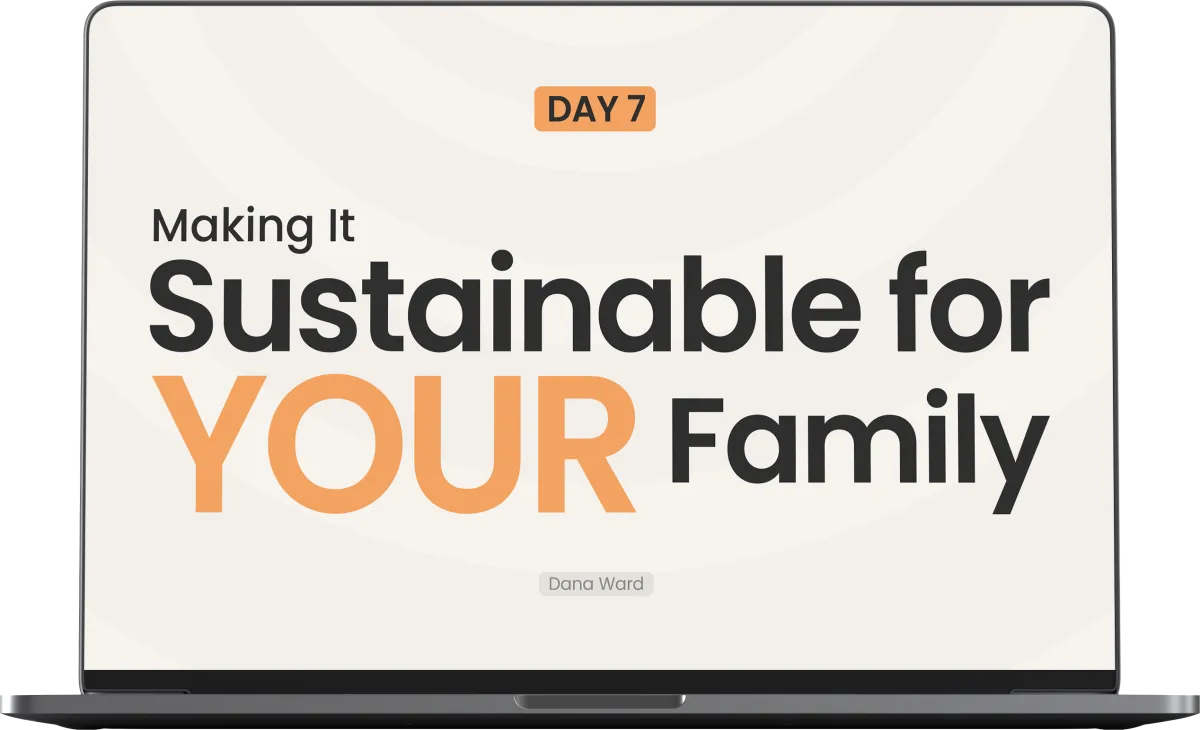
Bring everything together in a way that works for your real life
Choose the strategies that matter most for your family
Adapt the tools to your child and your routines
Plan for common obstacles and difficult days
By the end of Day 7: You’ll have a personalized framework you can continue using beyond the Reset
Small Changes Can Create a Ripple Effect Throughout Your Home
When you create more predictable routines and use calmer, more consistent tools, the effects can reach beyond one difficult moment.
Your mornings may begin to feel more organized because everyone has a clearer idea of what comes next.
After-school transitions can become easier to navigate when your child has time and support to shift from school to home.
Big emotions will still happen—but you'll have practical tools and language to help you respond with more confidence and calm.
Clearer expectations and consistent language can also help the adults in your home respond more consistently, reducing some of the confusion that can lead to power struggles.
And small connection rituals give you intentional opportunities to reconnect with your child throughout the day—even when life is busy.
The goal isn't a perfect home or a child who never struggles.
It's a home with more predictability, more connection, and practical tools to help you handle the hard moments when they come.
What You're Getting Today
(Everything Included in Your Reset)

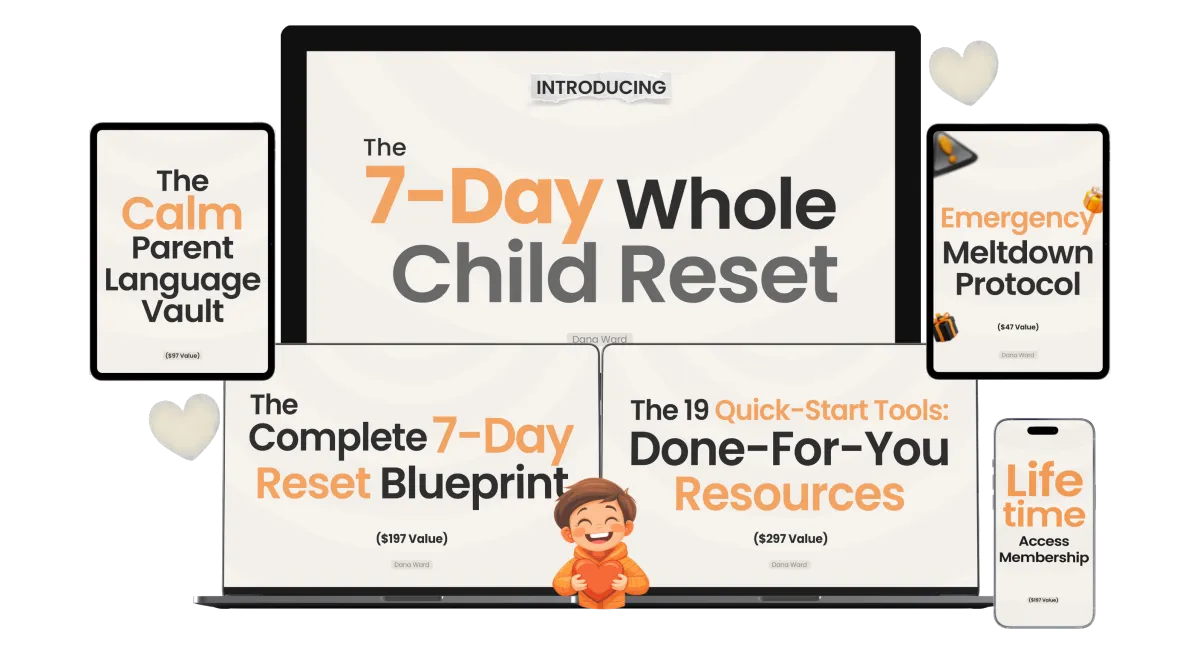
The Complete 7-Day Reset Blueprint
($197 Value)

Your comprehensive 25-30 page page step-by-step guide:
Day-by-day implementation plans with clear, manageable steps
Child development insights that help explain the “why” behind the strategies
Age-appropriate guidance for children ages 3–10
Troubleshooting support for common challenges
Guidance for adapting the strategies to different regulation and sensory needs
The 19 Quick-Start Tools: Done-For-You Resources
($297 Value)

19 print-and-use resources that make the Reset easier to put into practice at home:
Picture & Word Schedules — simplified versions for morning, after-school, and bedtime
Lunchbox Formula & 5-Day Rotation — simple support for meal and snack planning
Calm-Down Choice Pages — regulation options children can choose from
Connection Ritual Ideas — simple ways to build connection into the day
Simple Expectation Charts — clear visual reminders without overwhelm
Bedtime Routine Visuals — support for a more predictable bedtime routine
Movement Menus — simple movement choices for active bodies
Transition Scripts — helpful language for smoother transitions
When-Then Language Guides — clear language for expectations and follow-through
The Calm Parent Language Vault
($97 Value)

Ready-to-use language for challenging parenting moments:
50+ ready-to-use scripts for common challenging situations
De-escalation phrases for responding more calmly in tense moments
Connection-building responses for big emotions
Boundary-setting language for clear, consistent expectations
Repair scripts for reconnecting after a difficult moment
Emergency Meltdown Protocol
($47 Value)

When emotions escalate, you'll have a clear plan to follow:
A 5-step response sequence for navigating intense moments
Simple regulation strategies to help support a return to calm
Recovery and repair strategies for reconnecting afterward
Prevention planning to help prepare for future challenging moments
Lifetime Access to Your Reset Resources
($197 Value)

Your resources are yours to keep and revisit:
Instant digital access — start using your resources right away
Printable PDFs — print copies for your household as needed
Mobile-friendly access — view your resources on your devices
Lifetime access — return to the materials whenever you need them
Future updates included — receive updates to the resources when available
Easy to use with other caregivers — help keep routines and language consistent across the adults supporting your child
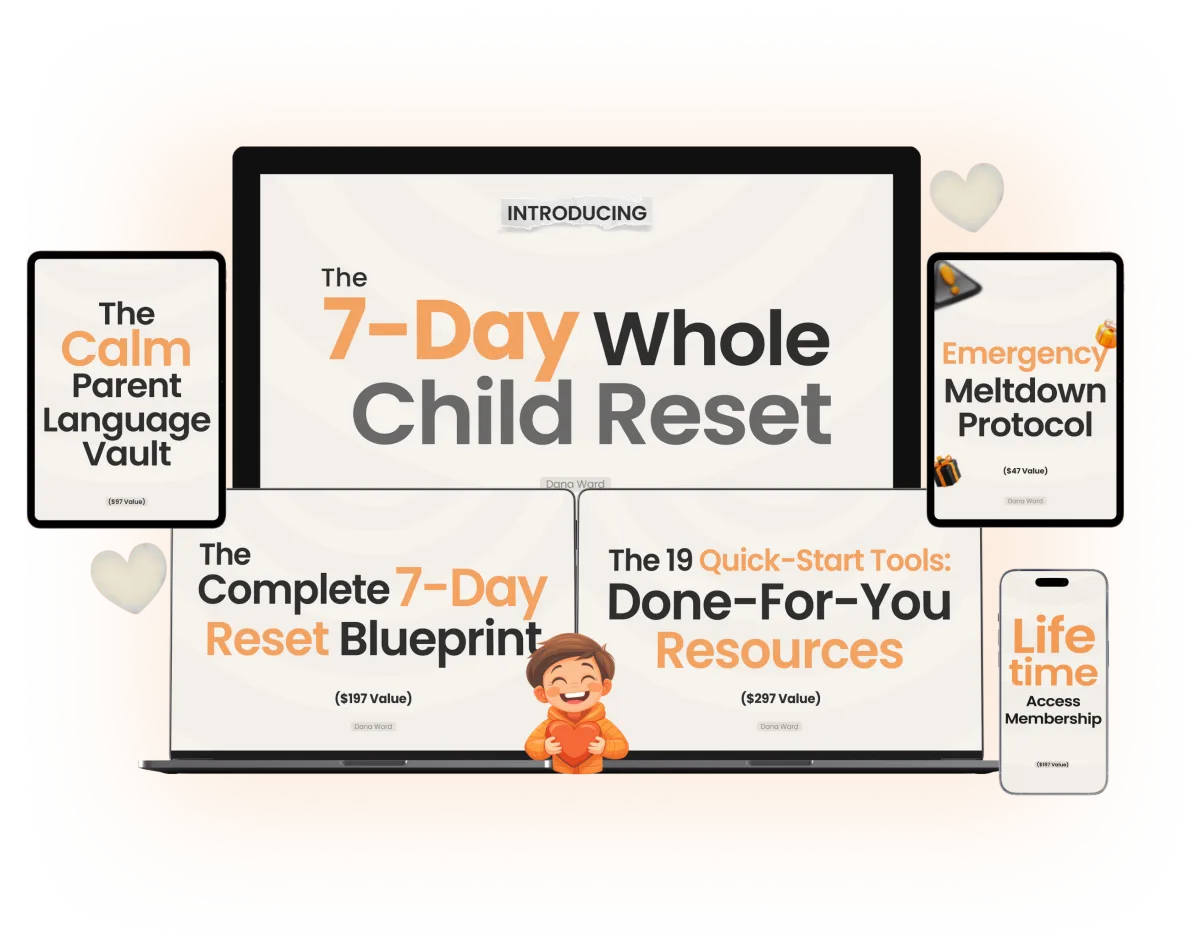
Total Real Value: $835
Your Investment: Just $27
Everything You Need to Get Started
The 7-Day Whole Child Reset brings the complete system together in one practical, easy-to-follow resource.
You’ll receive the step-by-step 7-day guide, 19 Quick-Start Tools, the Calm Parent Language Vault, the Emergency Meltdown Protocol, and lifetime access to your Reset resources.
Your Investment: Just $27
No subscription. No recurring payment. Just practical tools you can return to whenever your family needs a reset.
Is The 7-Day Whole Child Reset Right for You?
Here’s Who It Was Designed For
✅ The Reset Is a Great Fit If
Your child generally does well at school but struggles more at home
You want more predictable routines without relying heavily on punishments or rewards
Your child is between ages 3–10
You’re willing to make small, consistent changes to your family’s routines
You value connection, regulation, and clear expectations
You want practical tools you can adapt to your family
❌ The Reset May Not Be the Right Fit If…
You’re looking for a quick fix without making changes to your routines
You’re primarily looking for a strict punishment- or reward-based behavior program
You’re not ready to consistently practice new routines and strategies
You’re expecting every behavior challenge to disappear in seven days
You’re looking for individualized medical, mental health, or diagnostic advice
Two Paths From Here— Which One Feels Right for Your Family?
Path 1: Keep Trying to Figure It Out on Your Own
Tomorrow morning: You rely on the same routines and strategies you're already using.
Tomorrow afternoon: The transition from school to home may still feel harder than you'd like.
Tomorrow night: You may find yourself wondering what you could do differently.
Next week: You're still piecing together advice from different sources and trying to decide what might work for your family.
The challenge:
You don't have a clear, step-by-step system connecting the kinds of supports children respond to at school with what you can realistically use at home.
You can keep figuring it out on your own—but you don't have to.
Path 2: Start Building Your School-to-Home Bridge
Today: Get instant access to the Reset and choose where your family will begin.
Days 1–2: Create more predictable routines and begin supporting your child's energy and regulation.
Days 3–4: Practice tools for big emotions and add simple connection rituals to your day.
Days 5–6: Strengthen expectations and boundaries while supporting movement, sleep, and regulation.
Day 7: Identify what's working, make adjustments for your family, and create a realistic plan for moving forward.
Your investment: $27
You'll have the complete 7-day plan, practical tools, scripts, visuals, and resources to guide you along the way.
You don't have to change everything overnight. You just need a clear place to start.

Try the 7-Day Reset Risk-Free
Try The 7-Day Whole Child Reset for 7 days.
Go through the plan, use the tools that fit your family, and see how the approach feels in your home.
If you decide it isn't the right fit, simply email within 14 days for a full refund.
No complicated forms. No pressure.
Every family is different, and I want you to feel confident trying these strategies in your own home. If the Reset isn't right for your family, I want you to have your money back.
You have 14 days to explore the Reset and decide for yourself.
The Truth That Changes Everything
✅ Your child may need different support at home than they do at school.
✅ Struggling moments don't mean you're failing as a parent.
✅ Small, predictable supports can make a meaningful difference.
Think about the structure your child experiences throughout the school day: predictable routines, clear expectations, transition cues, visual supports, movement, connection, and adults helping them navigate difficult moments.
Home will never look exactly like school—and it shouldn't.
But you can borrow what works.
You can create routines that make the day more predictable.
You can use language that helps reduce power struggles.
You can build in connection and regulation before difficult moments happen.
That's the School-to-Home Bridge.
And The 7-Day Whole Child Reset gives you a simple, step-by-step way to begin building it for your family.
You don't have to change everything at once. You can start today.
Your Child Doesn't Need a Perfect Parent—They Need Support That Works at Home
Your child isn't trying to make family life difficult.
Big emotions, resistance, and challenging transitions can be signs that a child needs more support navigating the moment.
At school, children have predictable routines, clear expectations, transition cues, visual reminders, movement, and adults helping them know what comes next.
At home, you can create your own version of that support.
Not a classroom. Not a rigid schedule. A bridge.
A bridge between the structure that helps your child navigate the school day and the warmth, flexibility, and connection that make home feel like home.
That's what you're building with The 7-Day Whole Child Reset.
One routine. One tool. One small change at a time.
You Have 3 Options Right Now
Option 1: Keep doing what you're doing and hope things begin to feel easier on their own.
Option 2: Keep piecing together parenting tips, routines, and strategies from different sources and trying to figure out what works for your family.
Option 3: Invest $27 and spend the next 7 days following a clear, practical plan designed to help you create more predictable routines, support regulation, strengthen connection, and bring more consistency into your home.
Make the Decision Your Future Self Will Thank You For
✅ Instant Access — download your Reset materials and get started right away
✅ 14-Day Money-Back Guarantee — try the Reset and decide whether it's right for your family
✅ Lifetime Access — return to your materials whenever you need them
✅ Practical, Flexible Strategies — designed to be adapted to your child's individual needs
✅ Start Today — choose your starting point and begin building more predictable routines
Still Have Questions?
(I've Got You)
What if my child is different?
Your child is different. They're also human with a human nervous system that responds to support. The School-to-Home Bridge works for ADHD, autism, anxiety, and neurotypical kids because it addresses System Fragmentation, not specific diagnoses.
What if I can't stay consistent?
You don't need perfection. Consistent implementation gets results because the bridge supports itself. Plus, once routines are visual, KIDS help maintain them.
I've tried everything. Why would this work?
Because you've been trying to change behavior. This bridges the gap in systems. When you heal System Fragmentation, behavior changes naturally.
What if my partner won't do it?
One parent building the bridge is infinitely better than zero. Plus, when your partner sees it working, they'll want in.
Is this just for young kids?
The core systems work for ages 3-10. Teens need different approaches (though many parents report improvements with older kids too).
How much time does this really take?
15-30 minutes per day to implement. Once in place, the bridge SAVES you hours by preventing battles.
What if my child refuses to use the visuals?
This is covered in the troubleshooting section. Most resistance comes from introducing tools during dysregulation. We teach you how to introduce supports when your child is calm, making them feel helpful rather than forced.
What if I work full-time and don't have much time?
The system is designed for busy families. Most tools take 5-10 minutes to set up and then run themselves. You're not adding more to your plate — you're creating structure that reduces daily chaos and actually saves time.
What format is this delivered in?
Instant digital download as printable PDFs. Mobile-friendly so you can access on any device. Lifetime access means you can download as many times as you need, print multiple copies, and share with caregivers.
Do I need any special materials or expensive supplies?
No. Everything can be printed on regular paper. Most families use items they already have at home. Optional: laminating sheets or page protectors for durability, but not required.
The Moment That Changes Everything
Six months from now, you may look back on today as the day you decided to try something different.
✅ The day you started creating more predictable mornings.
✅ The day you began approaching after-school transitions differently.
✅ The day you added more structure and calm to bedtime.
✅ The day you started building more intentional connection with your child.
✅ The day you gave yourself practical tools instead of expecting yourself to simply “figure it out.”
You don't have to change everything today. You just need a clear place to start.
Your Family's Reset Can Start Today
Start Building Your School-to-Home Bridge Today — Just $27
P.S.
If you've made it this far, there's probably something about your family's routines that you're ready to make a little easier.
You don't need to overhaul your entire home. And you don't need to become a different kind of parent.
You just need a clear place to start.
The 7-Day Whole Child Reset gives you a step-by-step plan, practical tools, scripts, visuals, and resources you can begin using right away.
Take what works for your family. Adjust what needs adjusting. And give yourself seven days to begin building more predictability, connection, and calm into your home.
You can start today for $27.
Remember:
You don't need a perfect plan.
You need a practical place to begin.
The 7-Day Whole Child Reset gives you the tools to start building your School-to-Home Bridge today.
Instant Access • Lifetime Access • Just $27
🔒 100% Secure Checkout | Instant Digital Access | 14-Day Money-Back Guarantee